Methodology
How We Ship Software Without AI Slop
Developing software without AI slop requires a system for specifying, testing, and accepting each change. Generated code is a candidate until evidence supports the behaviour you intend to ship.
I use this article to explain Synetica’s approach: humans own the problem, specification, and product acceptance while AI handles bounded implementation tasks. The workflow still needs security review, operational ownership, and release checks appropriate to the risk.
This guide explains seven disciplines, the limits of external productivity research, and what clients and developers should inspect. The methodology is our recommendation, not a claim that every team can reproduce another company’s results.
TL;DR — the whole guide in five lines:
- AI slop is a process failure, not a model failure; unstructured prompting creates unmaintainable software.
- The Blueprint is the product: humans define the problem, constraints, user flows, and acceptance criteria before AI writes code.
- Fresh context beats long context: every implementation task gets a focused session instead of one bloated conversation.
- Humans validate outcomes, not code line by line; AI handles execution and review against the spec.
- The commercial win is speed with control: clients get production software faster because the system limits drift.
What is AI slop in software development?
Let’s start by being honest about the problem.
AI slop is what happens when you generate code without structure. You ask ChatGPT to build you a dashboard, it produces something that looks impressive, you ship it.
Three weeks later, a customer finds a bug. You ask the AI to fix the bug.
It introduces two more. You ask it to fix those.
The codebase becomes a layer cake of patches on top of patches, each one generated by an AI that had no memory of why the previous layers existed.
This is not a hypothetical. This is happening at scale right now, across the entire industry.
The invisible rework cost
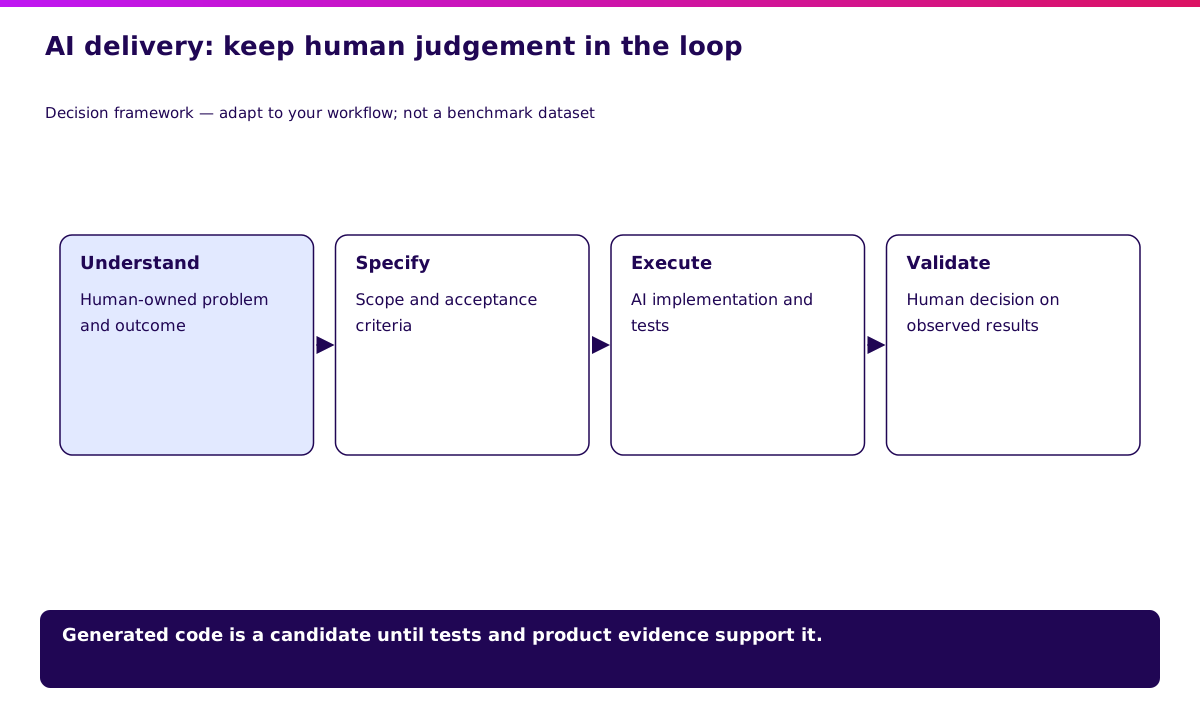 The Synetica development flow: understanding flows into specification, specification drives AI execution, humans validate the outcome — not the code. View full size →
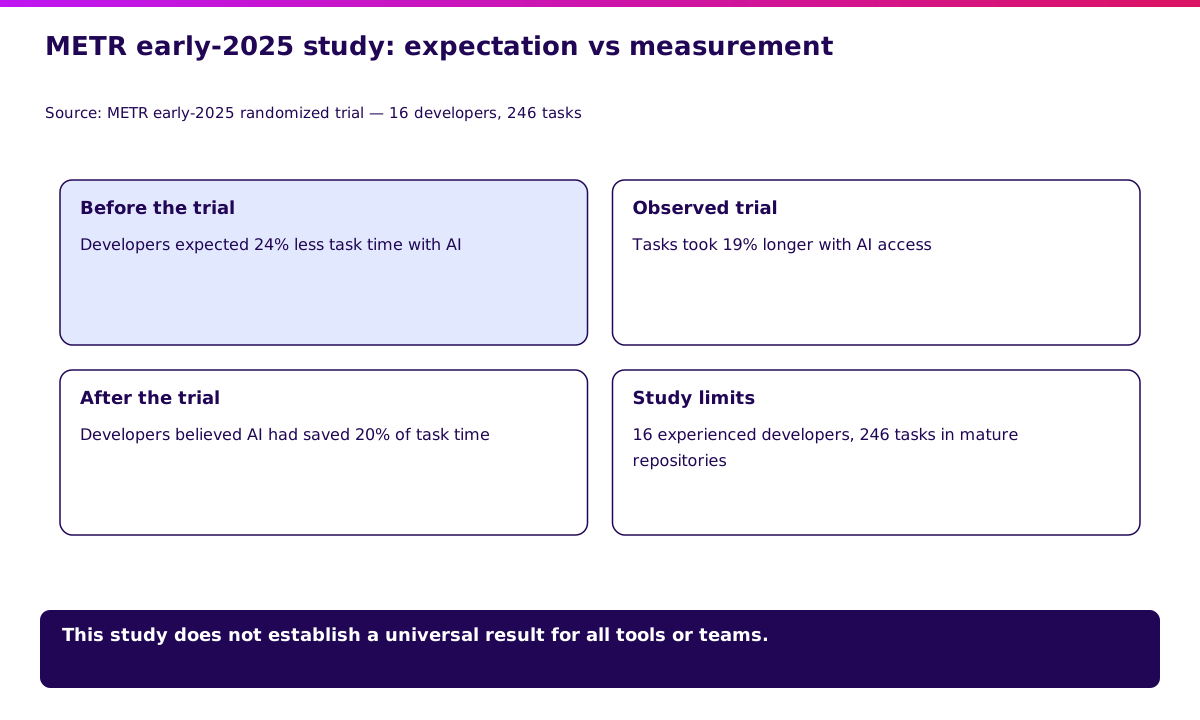
METR’s early-2025 randomized trial studied 16 experienced developers completing 246 tasks in mature repositories. AI access increased completion time by 19% in that setting; participants expected a 24% reduction before the trial and believed they had saved 20% afterward.
This is a finding about those developers, repositories, tasks, and early-2025 tools. It does not prove that unstructured workflows caused the slowdown, or that every AI team is slower. METR’s February 2026 update explains why selection effects complicate follow-up measurement.
What should an AI delivery team measure?
| AI slop signal | What it feels like | What it usually means | Guardrail |
|---|---|---|---|
| Fast first draft | The screen fills up quickly | Requirements are still implicit | Write acceptance criteria first |
| Repeated bug fixes | Each patch creates a new issue | The model is guessing at intent | Return to the Blueprint |
| Confident output | The answer sounds complete | Confidence is not verification | Run tests and use the product |
| Long chat history | The assistant remembers everything | Context is polluted | Split planning from execution |
How is this possible? Because AI makes you feel productive.
Tokens are flowing. Code is appearing.
Screens are filling up. But feeling productive and being productive are different things.
The AI generates code quickly, but the human spends more time debugging, understanding, and fixing the AI’s output than they would have spent writing it themselves.
This is the slop trap. Speed without structure produces volume without quality.
Where high-quality AI teams differ
StrongDM describes its Software Factory as a process where specifications and scenarios guide agents that write and validate code without traditional human code review. This is a company account of its workflow, separate from the METR experiment.
“Code must not be written by humans.” — StrongDM Software Factory
That design still needs an end-to-end validation harness and humans who decide whether the result is acceptable. It is an example to inspect, not evidence that every product should remove human code review.
So the question isn’t whether AI can produce quality code. It clearly can.
The question is: what’s the difference between the teams that ship clean AI-generated code and the teams that ship slop?
The answer is the system around the AI, not the AI itself.
The Slop vs Quality Matrix:
| High Structure | Low Structure | |
|---|---|---|
| With AI | ✅ Quality at scale (Synetica) | ⚠️ AI Slop (vibe coding) |
| Without AI | 🐢 Quality but slow (traditional) | 💥 Chaos (cowboy coding) |
The question is never “should we use AI?” — it’s “do we have the structure to use AI well?”
How does AI software development avoid slop? Seven disciplines
We don’t call them “rules” or “best practices.” We call them disciplines, because that’s what they require. Each one is a deliberate choice to slow down at specific moments so that the overall process moves faster and produces better results.
Discipline 1: The Specification Is the Product
This is the foundation of everything we do at Synetica. It comes from a belief I’ve held for 15 years but couldn’t act on until AI made it practical: the value in software development was never in the coding.
It was always in understanding the problem.
I wrote about this in detail in “The Code Is Not the Point Anymore.” The short version: for a decade, the Indonesian software industry (and honestly, the global industry) charged clients for developer hours. Six people, six months, a hundred million rupiah.
But most of the value was delivered in the first two weeks — when someone actually sat down and understood what the client needed.
The remaining five and a half months? That was building.
Slowly. With miscommunication.
With requirements that drifted. With code reviews that caught syntax but missed intent.
AI just made the building part free. Which means the only thing worth paying for is the understanding.
What the Blueprint actually contains
At Synetica, we capture that understanding in what we call a Blueprint — a comprehensive specification that’s detailed enough for an AI agent to build from without ambiguity. (It’s the same Blueprint that anchors our Blueprint & Prototype service, and we’ve documented the methodology behind it separately.) A Blueprint includes:
- The actual problem — not what the client asked for, but what they actually need. These are often different. A client says “we need a CRM.” What they actually need is to stop losing leads between the sales call and the follow-up because three departments don’t talk to each other. (This is the same failure pattern we unpack in why digital transformation projects fail inside growing companies.)
- System boundaries — what’s in scope, what’s explicitly out of scope, and what’s a future change request. This is critical because AI agents will happily build things you didn’t ask for if you don’t tell them not to.
Turning intent into testable constraints
- Data architecture — entities, relationships, constraints, validation rules. Not a rough sketch. A precise specification that leaves no room for the AI to make assumptions.
- User flows — step by step, including the edge cases that break most software. What happens when the user enters invalid data? What happens when two users try to approve the same thing simultaneously? What happens when the network drops?
- Acceptance criteria — measurable, testable conditions for “done.” Not “it should work.” But “when the user submits the form with valid data, the system should save the record and redirect to the dashboard within 2 seconds.”
- Testing strategy — what gets tested, how, and when. This is not an afterthought. It’s part of the spec.
Why this pays off
A clear specification makes the intended behaviour reviewable before implementation. That is the benefit to test against your own rework baseline.
The discipline: No code is generated until the Blueprint is complete. No exceptions. If the spec has gaps, we go back to the client, not to the AI.
Discipline 2: Plan Big, Execute Fresh
This is the single most impactful technical discipline we practice, and it comes from a simple observation about how AI models work.
A long session can mix superseded decisions, unrelated code, and the current task. I would preserve the agreed specification and handoff notes, then give each implementation task only the context needed to complete and verify it.
There is no universal “50% of context” threshold established by the evidence cited here. Measure failures in your own task set, and check whether splitting the task improves completion quality and review effort.
How fresh-context execution works
Here’s how we apply this:
Phase 1: Planning (one deep session) We load the Blueprint, discuss architecture, make design decisions, and produce a structured task breakdown. This session can go long — 80K, 90K, even 100K tokens is fine because we’re thinking, not coding. The output of this session is a task plan document.
Phase 2: Execution (many fresh sessions) Each task from the plan gets its own fresh session. The AI receives only three things: the relevant section of the Blueprint, the relevant existing code, and the task description. Nothing else. No history of previous tasks. No conversation about the weather. Just clean, focused context.
| Context choice | Good for | Risk if misused | Synetica rule |
|---|---|---|---|
| Long planning session | Architecture, trade-offs, task sequencing | Starting implementation with stale noise | Export the plan, then stop |
| Fresh task session | Focused execution | Missing relevant code context | Load only the needed files |
| Review session | Independent critique | Rubber-stamping the builder | Use a separate reviewer context |
| Handoff session | Documentation and QA | Losing the original decision trail | Link back to the Blueprint section |
This is counterintuitive. Most people think keeping the AI in one long session gives it “more context” and therefore better results.
The opposite is true. A focused AI with 20K tokens of relevant context outperforms a distracted AI with 90K tokens of mixed context every time.
The discipline: Planning and execution happen in separate sessions. Every implementation task starts with a fresh context window. No exceptions.
Discipline 3: Tests Before Code (And AI Writes Both)
Test-driven development has been preached for decades. Most teams still don’t do it.
The reason is that writing tests is tedious, and developers — being human — naturally gravitate toward the interesting work (writing the feature) and away from the boring work (writing the tests).
AI doesn’t have this bias. AI will happily write tests all day long.
The Superpowers framework, which has been gaining significant traction in the Claude Code and Cursor communities, formalizes this into a strict sequence:
1. Read the spec → 2. Generate tests from the spec → 3. Write code to pass the tests → 4. Verify tests pass → 5. Check against the original planThe critical insight is step 2: the AI writes tests directly from the specification, before it writes any implementation code. This means the tests reflect what the spec says should happen, not what the code happens to do. It’s the difference between “does this code work?” and “does this code do what we specified?”
The plan-verify loop
Step 5 checks the implementation against the original acceptance criteria. After each implementation task, the AI goes back to the original plan and verifies that the code matches the success criteria defined at the planning stage.
This helps catch a failure mode in AI-assisted development: plan drift. An agent can produce plausible work that drifts from the agreed criteria. Review each completed task against the original requirement.
The plan-verify loop catches this before it compounds.
At Synetica, we use this exact flow. Every feature has tests generated from the Blueprint before a single line of implementation code exists.
The tests are the contract between the spec and the code. Passing tests provides evidence for the cases covered; it does not prove the specification or implementation is complete.
If they don’t, we know immediately.
The discipline: Tests are always generated before implementation code. After each task, the AI verifies its output against the original plan. No implementation proceeds without this verification.
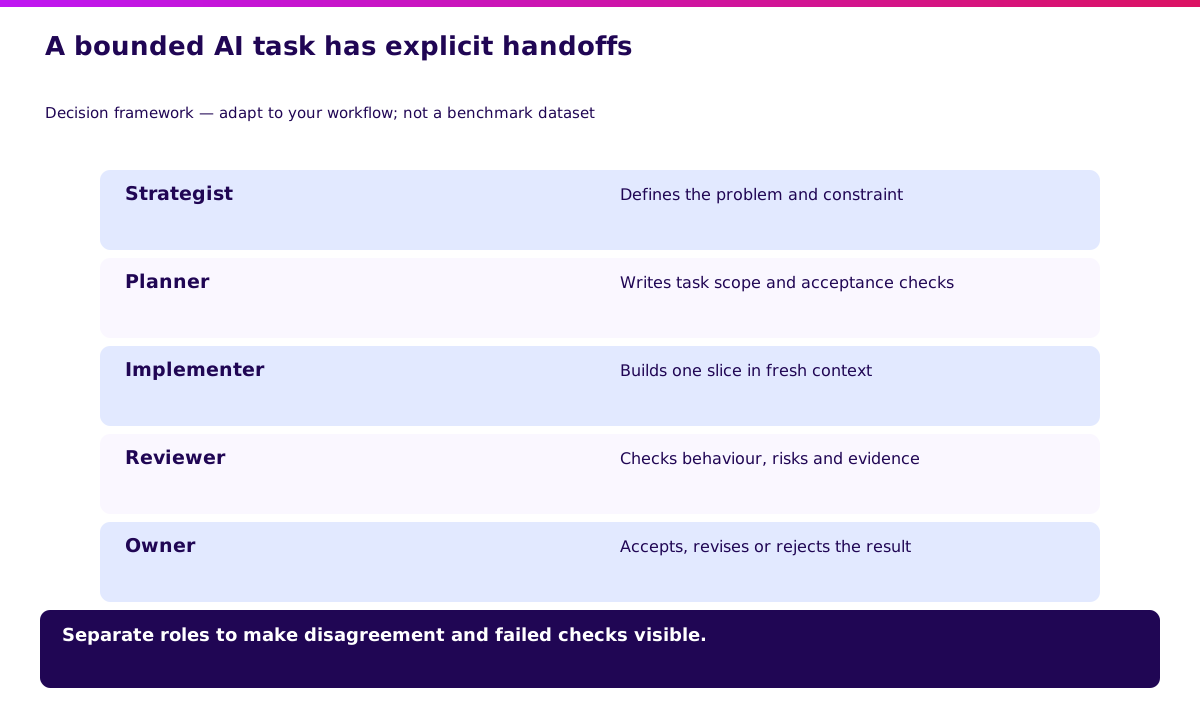 The complete sequence: Product Strategist writes the spec → AI generates tests → AI builds code → AI reviews → Human validates the product (not the code). View full size →
Discipline 4: Right Model, Right Job
Not all AI models are the same. Using the wrong model for the wrong task is one of the fastest paths to slop — and one of the least discussed.
Evaluate candidate models on the same representative tasks and acceptance criteria. Record correctness, missing requirements, latency, cost, and the review work left for a human.
A strong result on one audit prompt does not establish the best model for planning, implementation, or product acceptance. Repeat the evaluation when the model, tool access, or task distribution changes.
Matching model strength to task shape
Here’s how we allocate models at Synetica:
Specification and architecture: Opus 4.6 or equivalent. These tasks require nuance, ambiguity handling, deep context understanding, and the ability to reason about tradeoffs. This is where the most expensive models earn their cost.
Code generation: Codex (GPT-5.3) or Claude Code. These models are purpose-built for code production and have been trained specifically on development workflows. They’re not the best at thinking — they’re the best at building.
Code review and auditing: Sonnet 4.6 or GPT-5.2 Low. Procedural, checklist-driven tasks. Run through this codebase and flag security issues, performance anti-patterns, and inconsistencies. These models are fast, cheap, and surprisingly thorough for pattern-matching tasks.
Bug fixing and iteration: Codex or Claude Code with tool access. These need the ability to read files, run tests, and iterate — not deep reasoning ability.
The principle: smart model writes the prompt, appropriate model executes it. Your most expensive model should be doing the thinking. Your execution models should be doing the building. Using Opus for everything is like paying a CEO to stuff envelopes.
The discipline: Every task is assigned to the model best suited for that task type. We maintain a model allocation guide that the team follows.
Discipline 5: Small Chunks, Small Blast Radius
Every experienced AI developer eventually converges on the same conclusion: smaller tasks produce better results.
Addy Osmani puts it clearly: “LLMs do best when given focused prompts — implement one function, fix one bug, add one feature at a time.”
Cursor’s official best practices guide, released recently, echoes this: the difference between a productive AI developer and one who generates slop is planning and task decomposition. Vibe coders jump in and start throwing prompts.
Effective developers break work into focused, independent tasks.
This isn’t just about AI quality. It’s about blast radius.
When you ask an AI to “build the entire authentication system,” and it makes a bad architectural decision in the first 50 lines, that decision propagates through every subsequent line of code. By the time you discover the mistake, it’s baked into 2,000 lines across 15 files.
Fixing it means regenerating everything.
When you ask an AI to “implement the login form validation,” and it makes a bad decision, you’ve lost 50 lines. You throw them away, clarify the spec, and regenerate.
Two minutes, not two hours.
The task-size rule
Our task size rule:
- One task = one feature, one function, or one fix
- Each task has a clear input (section of the Blueprint) and a clear output (working code + passing tests)
- Each task runs in its own fresh context (see Discipline 2)
- Never ask the AI to “build the whole thing” — even if you think it can
Small chunks also enable parallelism. If you have five independent features to build, you can run five separate AI sessions simultaneously, each working on one feature with full focus.
This is exactly what Cursor’s new sub-agent feature enables, and what Claude’s Agent Teams functionality supports.
Separate tasks can run in parallel when their boundaries and shared interfaces are explicit. Keep one owner for integration and resolve conflicting assumptions before merging the results.
The discipline: Every implementation task is scoped to the smallest meaningful unit of work. Each task runs independently. Parallelism is preferred over sequential large sessions.
Discipline 6: AI Reviews AI (Humans Review the Product)
This is the discipline that confuses people the most when they hear “zero code review.”
We absolutely review. We just don’t review code.
Here’s the distinction:
Traditional code review: A human developer reads every line of code another developer wrote. They check for syntax errors, logic bugs, security vulnerabilities, performance issues, and style violations. This is time-consuming, inconsistent (humans miss things), and scales poorly.
How does product review differ?
Our review process:
Step 1: AI Agent A generates code from the spec (e.g., Codex)
Step 2: AI Agent B reviews the code (e.g., CodeRabbit, Sonnet, or a separate Claude session)
Step 3: AI Agent B flags issues → AI Agent A fixes them
Step 4: Automated tests run (generated in Discipline 3)
Step 5: Human uses the product and validates it against the Blueprint
The human never reads the code. The human uses the product and asks: “Does this do what we specified?
Does it solve the client’s problem?”
This is a fundamentally different question than “Is this code clean?” Clean code that solves the wrong problem is worse than messy code that solves the right problem. Our focus is on the outcome, not the implementation.
The AI-to-AI review layer catches the technical issues:
- Security vulnerabilities (SQL injection, XSS, authentication bypasses)
- Performance anti-patterns (N+1 queries, memory leaks, unnecessary re-renders)
- Dependency issues (outdated packages, license conflicts, supply chain risks)
- Architectural violations (code that doesn’t follow the patterns established in the spec)
- Logic errors (edge cases, off-by-one errors, null reference bugs)
AI is actually better than humans at most of these checks. It’s more thorough (it never gets tired), more consistent (it checks the same things every time), and faster (it can review thousands of lines in seconds).
What AI is NOT good at is judgment. Does this feature actually solve the user’s problem?
Is this the right tradeoff? Will the client understand this interface?
These are human questions, and they’re answered by using the product, not by reading the code.
The discipline: Code is reviewed by AI agents, never by humans. Humans review the product against the specification. Technical quality is automated. Product quality is human.
Review Ownership Split
| Review layer | Reviewer | What gets checked | Evidence required |
|---|---|---|---|
| Static checks | Tooling | Syntax, types, lint, formatting | Clean command output |
| Automated tests | AI-generated test suite | Acceptance criteria from the Blueprint | Passing test run |
| Code critique | Separate AI reviewer | Security, performance, architecture drift | Actionable findings or clean report |
| Product validation | Human strategist | Workflow fit, user clarity, business outcome | Used product against the Blueprint |
Discipline 7: The Spec Is the Living Contract
The Blueprint doesn’t die after code is generated. It remains the living contract throughout the project lifecycle.
Most development teams treat the spec as a starting document — useful at the beginning, increasingly irrelevant as development progresses. By the time the project ships, the spec and the code have diverged so much that the spec is essentially fiction.
Keeping spec and code aligned
We prevent this by making the Blueprint the reference document at every stage:
During development: Every task references a specific section of the Blueprint. The AI is instructed: “Implement section 3.2 of the Blueprint.” After implementation, the AI is asked: “Does this implementation satisfy the acceptance criteria in section 3.2?” This creates a traceable chain from spec to code.
During review: The AI reviewer checks code against the Blueprint, not just against general best practices. “The spec says this endpoint should return paginated results with a maximum of 50 items per page. Verify this is implemented correctly.”
Validation and handoff
During validation: The human tester uses the acceptance criteria from the Blueprint as a checklist. Did the feature meet every criterion? If yes, it ships. If no, the gap is identified and sent back for rework.
During maintenance: Six months later, when a bug is reported or a change is requested, the first step is always reading the Blueprint. What was the original intent? What were the constraints? This context is essential for the AI to make a targeted fix rather than a blind patch.
During handoff: When a project is delivered to the client, the Blueprint is part of the deliverable. It’s the documentation. Not auto-generated API docs. Not code comments. The actual specification that explains why every decision was made.
This is what makes our approach sustainable. Code without a spec is a black box.
Code with a spec is a system you can understand, modify, and maintain — whether the next person working on it is human or AI.
Traditional vs Spec-Driven Development:
| Traditional Development | Spec-Driven Development (Synetica) |
|---|---|
| Vague requirements | Precise Blueprint with acceptance criteria |
| Human writes code | AI generates code from spec |
| Human reviews code line by line | AI reviews code automatically |
| Tests added after (if at all) | Tests generated BEFORE code |
| Spec and code diverge over time | Spec is the living contract |
| Knowledge lives in developers’ heads | Knowledge lives in the Blueprint |
| Hard to maintain after handoff | Anyone (human or AI) can maintain |
The discipline: The Blueprint is maintained throughout the project lifecycle. Every implementation, review, and validation references the spec. The spec and the code are never allowed to diverge.
Why This Works (The Deeper Pattern)
If you look at these seven disciplines as a system, a deeper pattern emerges:
**Humans do the understanding. AI does the building.
The spec connects them.**
Human understands the problem      → Blueprint
AI generates tests from Blueprint  → Test suite
AI generates code from Blueprint   → Implementation
AI reviews code against Blueprint  → Quality check
Human validates product vs Blueprint → Final verification
The spec is the bridge between human understanding and machine execution. It’s the translation layer that ensures what the human understands and what the AI builds are the same thing.
Without that bridge, you get slop. The AI builds something that looks plausible but doesn’t match what the client actually needs.
The developer doesn’t catch it because they’re reviewing code, not outcomes. The client gets something that technically works but doesn’t solve their problem.
With the bridge, you get alignment. Every decision traces back to the specification.
Every line of code exists for a reason documented in the Blueprint. Every test validates something the client said they needed.
This is not a new idea. It’s the oldest idea in software engineering — specification-driven development.
We just couldn’t do it before because writing code was so expensive that we had to cut corners on specification. Now that code is essentially free, we can finally invest fully in the part that always mattered.
Validate it in 2 weeks. A Blueprint session turns this thinking into a tested prototype in front of real users — see how Blueprint & Prototype works.
The Cost of NOT Doing This
Let me be direct about what happens when you skip these disciplines.
I’ve seen it. We’ve all seen it.
A team adopts AI coding tools, productivity spikes for the first two weeks, and then something changes. The codebase becomes harder to navigate.
Bugs start appearing in parts of the code nobody touched recently. The team spends more time debugging AI-generated code than they would have spent writing it manually.
This is the AI productivity paradox, and it’s exactly what the METR study measured. The developers thought they were faster.
They were actually slower. Because they were generating volume without structure.
The cost is real:
Technical debt accumulates invisibly. AI-generated code that “works” but wasn’t specified or tested properly becomes the foundation for future features. Each layer of unspecified code makes the next layer harder to build correctly.
Client trust erodes. When bugs appear in production, when features don’t match expectations, when changes take longer than expected — clients lose confidence. They don’t know or care that AI wrote the code. They care that it doesn’t work.
The team burns out. Debugging code you didn’t write and don’t understand is exhausting. It’s worse than writing code from scratch because you have to first understand what the AI was trying to do, then figure out where it went wrong, then fix it without breaking something else.
These are not theoretical risks. These are the actual, documented experiences of teams that adopted AI coding tools without a system to manage quality.
Next: How to Assess AI Development Ownership.
How to Assess AI Development Ownership
This is an editorial framework for reviewing responsibility, not an industry standard or a measured risk ranking. More automation does not automatically mean a better or safer system.
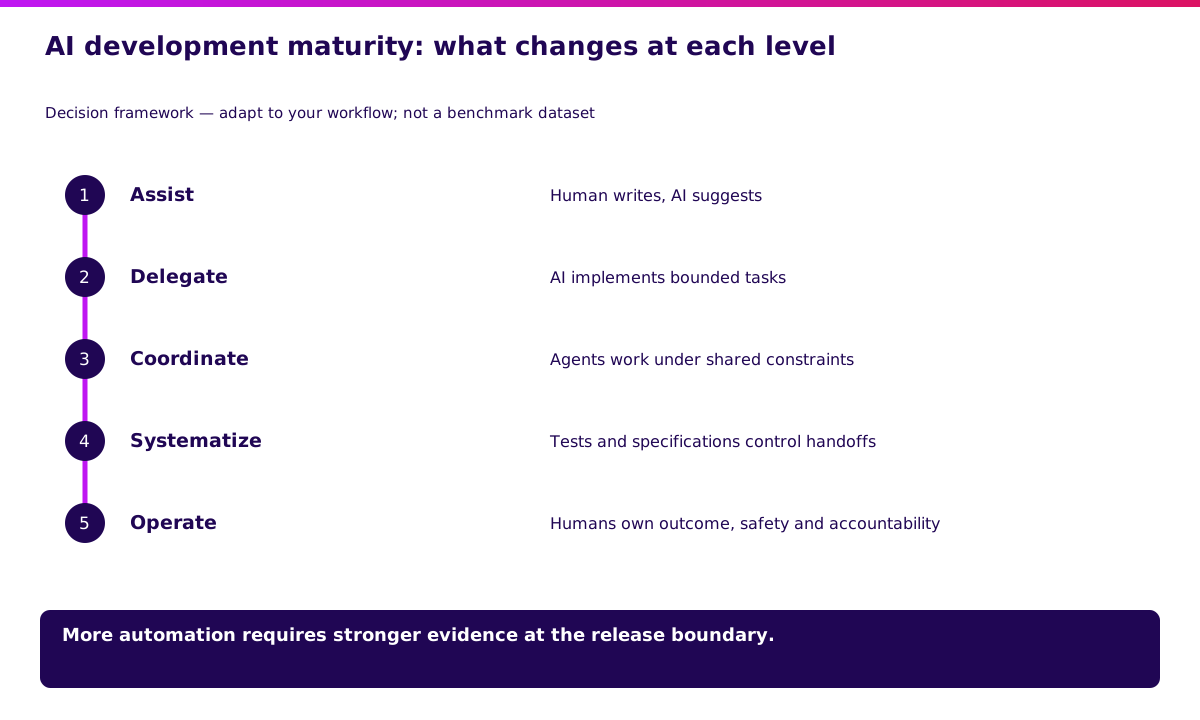
| Pattern | AI contribution | Human responsibility |
|---|---|---|
| Assist | Suggest candidates | Write and verify the change |
| Delegate | Implement a bounded task | Define criteria and check the result |
| Coordinate | Work across explicit agent roles | Resolve interface and integration conflicts |
| Systematize | Run specification-driven checks | Review coverage, failures and unresolved risks |
| Operate | Support monitored delivery workflows | Own release, security, recovery and outcomes |
Use the framework to ask who can reject a release and on what evidence. Synetica’s approach combines bounded implementation with specification-driven checks and human product acceptance.
Review the seven disciplines together.
The Seven Disciplines at a Glance
| # | Discipline | What It Prevents | Key Principle |
|---|---|---|---|
| 1 | Spec Is the Product | Building the wrong thing | Understand before you build |
| 2 | Plan Big, Execute Fresh | Context overflow hallucination | Focused context per task; measure errors and review effort |
| 3 | Tests Before Code | Untested, unverified output | AI writes tests from spec FIRST |
| 4 | Right Model, Right Job | Overpowered model overthinking | Smart model thinks, cheap model executes |
| 5 | Small Chunks | Cascading failures | One task, one feature, one session |
| 6 | AI Reviews AI | Security holes, anti-patterns | Humans review product, not code |
| 7 | Spec as Living Contract | Spec-code drift | Blueprint maintained throughout lifecycle |
Next: What This Means for Clients.
What This Means for Clients
If you’re a client reading this, here’s what you should take away:
You’re not paying for code. Code is a commodity. Any AI can generate a login page, a dashboard, an API. What you’re paying for is the specification — the certainty that we understood your problem correctly and will build exactly what you need.
You’ll see the spec before any code exists. Our Blueprint is a deliverable, not an internal document. You review it. You challenge it. You approve it. Only then does development begin.
Quality is built into the process, not bolted on after. We don’t write code and then check if it’s good. We specify what “good” means first, generate tests for it, then generate code that passes those tests. Quality is structural, not aspirational.
Your project can be maintained by anyone. Because the Blueprint exists and is maintained, any developer (human or AI) can understand, modify, and extend your system. You’re never locked into a single vendor or a single AI model.
Next: What This Means for Developers.
What This Means for Developers
AI assistance changes implementation work, but it does not remove the need to understand systems. I would evaluate a developer by the quality of the decisions and evidence they bring to a release.
| Skill | Useful contribution | Evidence to inspect |
|---|---|---|
| Discovery | Understand a real workflow and its constraints | A problem statement tied to recent behaviour |
| Specification | Define outcomes, boundaries and exceptions | Acceptance criteria another person can test |
| Engineering | Make the implementation reliable and maintainable | Tests, recovery, access controls and operating notes |
| Communication | Surface uncertainty before it becomes rework | Clear trade-offs and a recorded decision |
Which skills support reliable AI delivery?
Listening: ask the operator to show a recent task, including where it failed. Translate the observed constraint into a question the team can test.
Writing: describe the intended behaviour and non-goals precisely. A specification should tell both a developer and an agent how to recognise a wrong result.
Domain knowledge: learn the records, exceptions, and responsibilities in the business you serve. Technology alone does not tell you whether a returned order should reverse stock, revenue, or both.
Judgement: decide when evidence is insufficient. Escalate a security or data risk to a qualified reviewer rather than treating a passing generated test as approval.
Start with two disciplines and inspect their results.
Start Here
If you want to adopt this approach, don’t try to implement all seven disciplines at once. Start with two:
| Adoption stage | What to add | What to ignore for now | Success signal |
|---|---|---|---|
| Week 1 | One-page spec before code | Perfect process documentation | Fewer confused retries |
| Week 2 | Fresh session per task | Multi-agent orchestration | Smaller, cleaner diffs |
| Week 3 | Tests from the spec | Full coverage theater | Bugs show up before release |
| Week 4 | Separate AI review | Human line-by-line review | Issues are specific and fixable |
-
Write a spec before generating any code. Even if it’s rough. Even if it’s one page. The act of specifying forces you to think before you build. This alone eliminates half of AI slop.
-
Use fresh sessions for each task. Stop using one long conversation. Break your work into tasks, start fresh for each one. This eliminates the context pollution that causes hallucination.
These two disciplines, practiced consistently, will produce noticeably better results within your first week. Add the others as you get comfortable.
And if you want to see what this looks like at scale — a team of Product Strategists, each supported by an AI replicant, delivering complete projects from specification to deployment without writing or reviewing a single line of code — that’s what we’re building at Synetica.
The code is not the point. It never was.
Ganis Atmawarin is the founder of Synetica, a tech-based business consultancy in Yogyakarta, Indonesia. Before starting Synetica in 2026, he spent 12 years at SoftwareSeni leading software delivery across Indonesia and Australia. He still can’t run 5K without stopping, but he’s working on it.
What evidence should an AI task handoff include?
Reproducible test brief — illustrative inputs, not observed client results.
| Handoff | Required input | Retained output |
|---|---|---|
| Specification to plan | Outcome, non-goals and failure cases | Bounded tasks and acceptance checks |
| Plan to implementation | Known interfaces and test fixtures | Code changes plus check results |
| Implementation to owner | Passing checks and unresolved risks | Accept, revise or reject with a reason |
How should you measure AI delivery quality?
Reproducible test brief — illustrative inputs, not observed client results.
| Measure | Comparison rule | Limit |
|---|---|---|
| Task lead time | Compare similar tasks and count review time | Tokens generated are not delivery |
| Escaped defects | Same severity definition and observation window | Small samples can mislead |
| Rework | Include corrections after acceptance | Fast first drafts can conceal later effort |
What must a release owner verify?
Reproducible test brief — illustrative inputs, not observed client results.
| Risk | Check | Release evidence |
|---|---|---|
| Data loss | Restore a representative backup | Reconciled records and recovery timing |
| Access failure | Test roles and tenant boundaries | Unauthorised access is denied |
| Bad deployment | Exercise rollback with migration constraints | Working recovery path and named owner |
Next: FAQ.
FAQ
What is AI slop in software development?
AI slop is software generated quickly without enough specification, testing, review, or ownership. It often looks finished at first, then becomes expensive when edge cases, bugs, and unclear intent stack up.
Can AI-generated code be production-ready?
Yes, if the system around it is strict. The critical pieces are a clear Blueprint, tests before implementation, small tasks, fresh execution context, and outcome validation by humans.
Do humans still need to review AI code?
Humans need to review the product, risks, and business fit. AI can review code against checklists and tests, but humans still own the judgment about whether the software solves the right problem.
What is the first step to avoid AI slop?
Write the spec before generating code. Even a one-page spec with scope, user flow, edge cases, and acceptance criteria will reduce drift immediately.
How does Synetica use AI in software projects?
Synetica uses AI for execution, testing, and review, while human strategists own discovery, specification, validation, and client decisions. The goal is faster delivery without losing control.
Sources
- METR: Early-2025 AI and Experienced Developer Productivity
- METR: February 2026 Experiment Design Update
- StrongDM: Software Factory
Related Posts
The 2-Week Blueprint · AI Development Company · Software Vendor Due Diligence
Two weeks to a real answer
Need help putting this into practice?
Book a Blueprint session and we'll turn the ideas in this article into a tested prototype in front of real users—2 weeks, from $3,000.