Guide
SIMRS: Hospital Management Information System Guide for 2026
SIMRS (Sistem Informasi Manajemen Rumah Sakit, a hospital management information system) is the software that connects registration, clinical records, pharmacy, lab, billing, and reporting into one operational record. This guide helps you decide what a hospital actually needs, what to verify about SATUSEHAT and BPJS, and when buying beats building.
I’m Ganis, founder of Synetica, a tech-based business consultancy. I am not a clinician or a regulator, and Synetica does not claim a hospital client in this article. Every cost figure is a planning simulation in rupiah, not a market survey and not a Synetica quote. For regulatory duties, treat this guide as a question list and confirm the current rules with Kemenkes and your legal adviser.
You’ll get a definition, the problems a SIMRS solves, modules by hospital size, a compliance checklist, a buy-or-build flow, a simulated budget, and a phased rollout.
TL;DR — the whole guide in five lines
- A SIMRS is one patient record across units, not a set of separate apps for registration, pharmacy, and billing.
- Size decides scope: a small clinic needs fewer modules than a 120-bed hospital, and paying for both the same way wastes money.
- Compliance is a delivery requirement: ask any vendor to demonstrate SATUSEHAT and BPJS integration in a test environment, not on a slide.
- Buy first, build only where your process differs: custom work belongs on the workflow that sets you apart.
- In our simulation, an IDR 460m build becomes IDR 618m in year one, and rollout goes one unit at a time.
What is a SIMRS?
A SIMRS is a hospital information system that records and moves patient, clinical, and financial data between units. Its job is to make sure the registration desk, doctor, pharmacy, lab, cashier, and management all work from the same facts.
- Front of house: patient registration, queues, appointments, and insurance status.
- Clinical: outpatient and inpatient records, orders, results, and discharge.
- Support: pharmacy, stock, laboratory, and radiology.
- Money: billing, cashier, claims, and financial reports.
- Management: roles, audit trails, dashboards, and regulatory reporting.
A SIMRS is not the same as a clinic app or a pharmacy POS. If you run a small clinic, our guides on stock management software and POS software cover the adjacent needs.
What problems does a SIMRS solve?
It removes the retyping and hand-offs that slow patients down and hide errors. These are the pain points that usually justify a SIMRS project:
- Repeated data entry: the same patient details are typed at registration, pharmacy, and billing.
- Lost context: a doctor cannot see an earlier lab result without a phone call.
- Slow billing: charges reach the cashier late, so discharge waits.
- Weak stock visibility: pharmacy runs out of one item while another expires.
- Painful reporting: monthly reports are assembled by hand from several spreadsheets.
A SIMRS cannot fix a broken process. It makes the process visible, so map the real patient journey before you compare software.
Which SIMRS features do you need by hospital size?
Match modules to your scale, then add only what a unit will actually use in its first six months. The table is a planning aid, not a standard.
| Module | Small clinic | Mid-size hospital | Multi-site group |
|---|---|---|---|
| Registration and queue | Core | Core | Core, shared patient ID |
| Outpatient record | Core | Core | Core, per-site templates |
| Inpatient and bed management | Not needed | Core | Core, cross-site transfer |
| Pharmacy and stock | Basic | Core | Core, central purchasing |
| Lab and radiology orders | Optional | Core | Core, central results |
| Billing and cashier | Core | Core | Core, consolidated finance |
| BPJS bridging | If you serve JKN | Core | Core |
| SATUSEHAT integration | Required to verify | Required to verify | Required to verify |
| Management dashboards | Basic | Standard | Consolidated |
The most common mistake is buying the “complete” package for a scale you do not have yet. Start from the units that create the most delay and add waves.
What compliance does a SIMRS need? SATUSEHAT, BPJS, and personal data
Compliance is the deepest part of this topic, and the one where a vendor’s slide proves nothing. Verify these items against current official sources before you sign:
- Electronic medical records: Permenkes 24/2022 on medical records set a deadline of 31 December 2023 for health facilities to adopt electronic medical records (RME) and expects them to connect to SATUSEHAT. Confirm the current text, including any later change, on JDIH Kemenkes.
- SATUSEHAT: Kemenkes’ national health data platform, built on the HL7 FHIR standard. Kemenkes publishes how facilities and RME providers integrate. Ask the vendor to show a working integration in a test environment.
- BPJS Kesehatan: if you serve JKN patients, ask which BPJS services the system bridges (for example eligibility, referral, queue, and claims) and check them against BPJS’s current technical documentation.
- Electronic system registration: reports on Permenkes 24/2022 indicate that RME providers must register as an electronic system operator (PSE) in the health sector. Ask the vendor for their registration status and verify it.
- Personal data: patient records are sensitive. Ask which access controls, audit logs, backups, and breach procedures exist, and confirm your obligations under Indonesia’s personal data protection law with a qualified adviser.
For general secure-development practices, NIST’s SSDF v1.1 is a shared vocabulary for buyers and suppliers. It is a reference, not a certification, and not Indonesian law.
SIMRS: ready-made or custom? Which fits your hospital
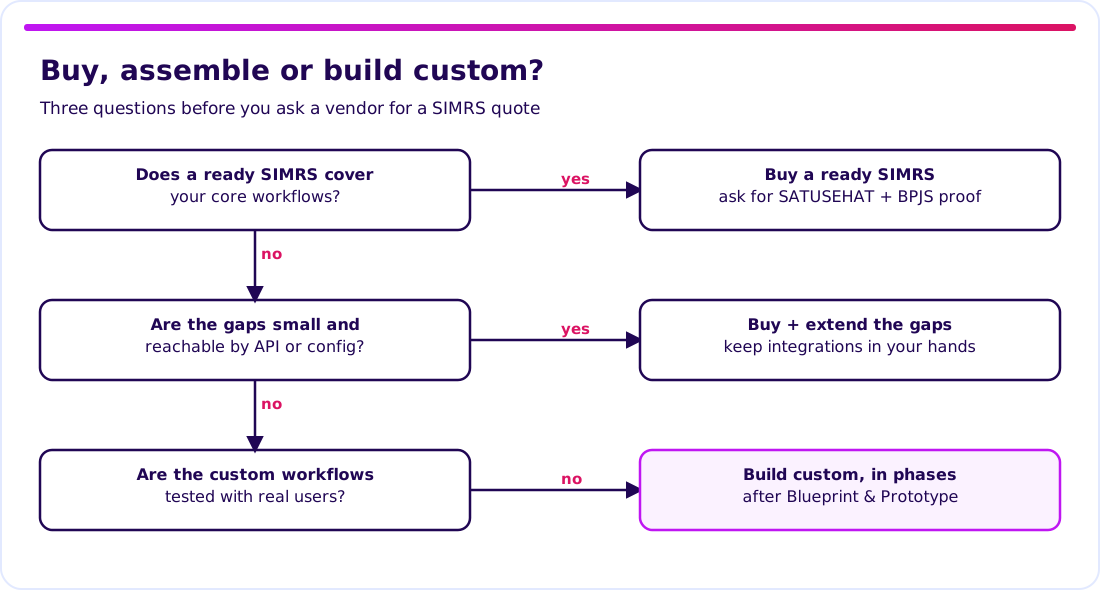
Buy a ready SIMRS when it covers your workflows; build custom only where your process differs. Answer the three questions in the flow below in order.
| Option | Strength | Risk to check | Best fit |
|---|---|---|---|
| Ready-made SIMRS | Faster start, tested modules | Fixed workflows, vendor dependency | A standard hospital process |
| Ready-made plus extensions | Keeps a proven core | Integration ownership and upgrade conflicts | A few specific gaps |
| Custom build | Fits your unique process | Larger scope, needs a decision owner | A differentiating workflow or deep integration |
Ready-made is often the right answer, and we will say so. Read our build vs buy guide and custom software development guide for the wider logic, and use the vendor due diligence checklist on every shortlist.
Validate it in 2 weeks. Before committing to a SIMRS budget, we test the riskiest workflow through Blueprint & Prototype: a specification, a prototype your staff can try, and cost figures based on real scope.
How much does a SIMRS cost and how long does it take to build?
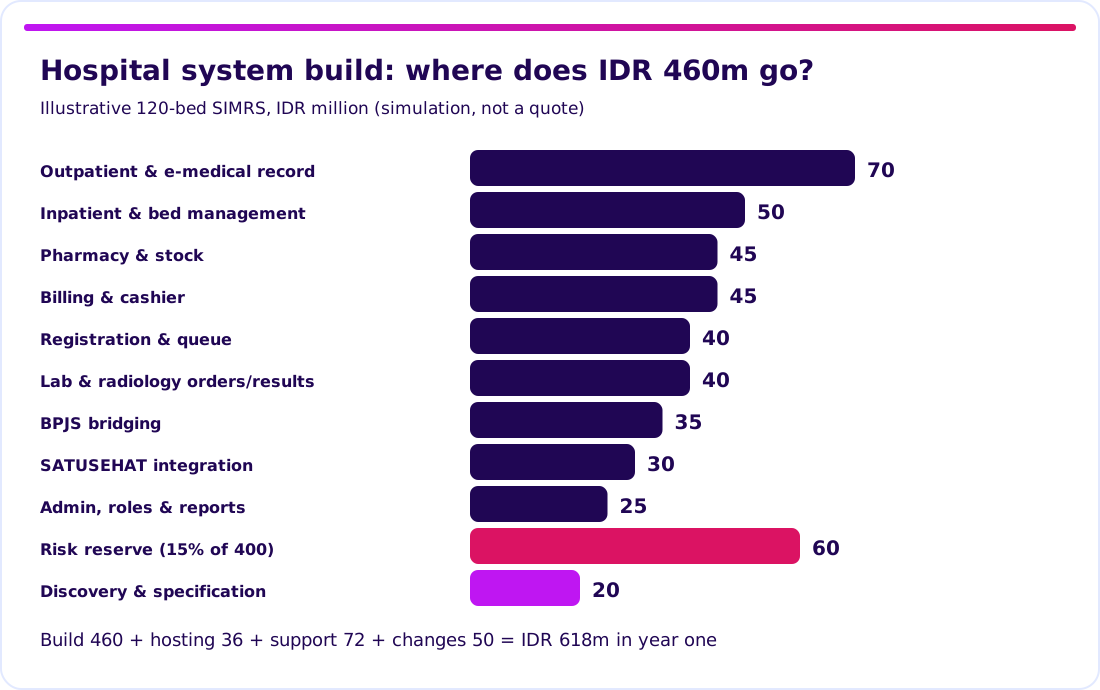
There is no single SIMRS price, because scope, integrations, and data migration dominate cost. The following is a simulation for a 120-bed hospital, in IDR million, not a market average and not a quote.
| Component | IDR m |
|---|---|
| Outpatient and electronic medical record | 70 |
| Inpatient and bed management | 50 |
| Pharmacy and stock | 45 |
| Billing and cashier | 45 |
| Registration and queue | 40 |
| Lab and radiology orders and results | 40 |
| BPJS bridging | 35 |
| SATUSEHAT integration | 30 |
| Admin, roles, and reports | 25 |
| Discovery and specification | 20 |
| Risk reserve (15% of 400) | 60 |
| Total build | 460 |
The nine modules add up to 70 + 50 + 45 + 45 + 40 + 40 + 35 + 30 + 25 = 380. Add discovery of 20 to reach 400; a 15% reserve is 400 × 0.15 = 60, so the build is 460.
After launch, add hosting and backup of IDR 36m, support of IDR 72m (IDR 6m a month), and post-release changes of IDR 50m. Year-one total: 460 + 36 + 72 + 50 = IDR 618m. Discovery is 20 of 460, or 4.3% of the build.
The simulation excludes hardware, network, staff training time, taxes, and data migration from legacy systems, each of which can be large. Add a line only when you can explain its basis.
A 22-week phased plan is below. The shape matters more than the numbers: one unit, one wave, one sign-off.
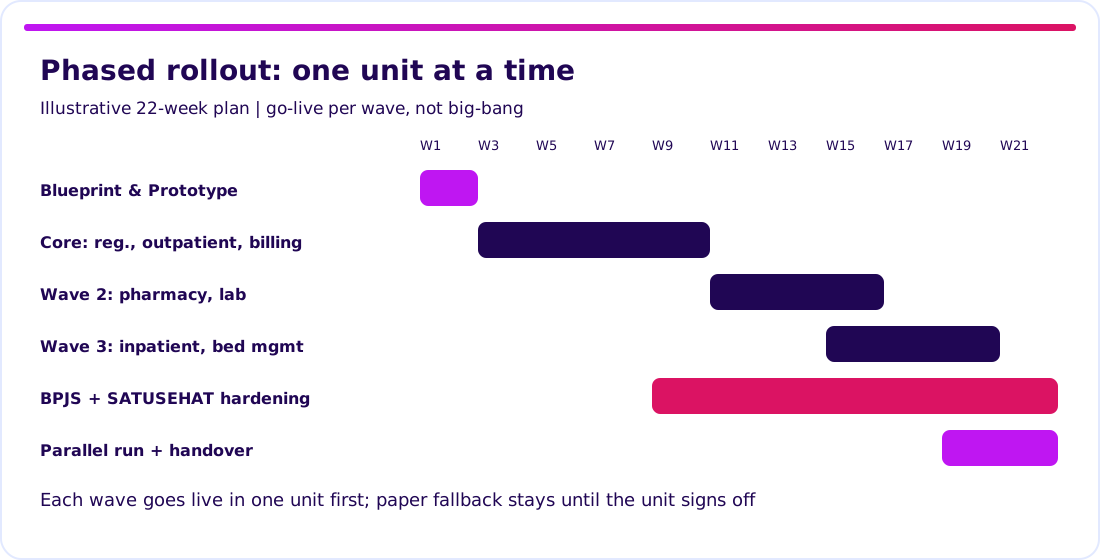
Synetica’s own path is two weeks of Blueprint & Prototype and eight weeks of Production Grade Software for a validated scope, then monthly Launch & Grow. A full hospital rollout is larger, so the plan above extends beyond the first release; it is an illustration, not our standard offer. See how the production phase works.
What are the red flags when choosing a SIMRS?
A red flag is an unanswered operational question, not a low price. Slow down when a vendor cannot show:
- A working SATUSEHAT and BPJS integration in a test environment.
- How a unit switches on without stopping patient service, and the paper fallback.
- Who owns your data, and how you export it if you leave.
- Role-based access and audit logs for patient records.
- What one extra module or integration costs after go-live.
- What happens after a failed deployment on a busy day.
A single big-bang go-live across every unit is the pattern we would question first.
What I would do before choosing a SIMRS
I would pick one unit with visible delay and test one patient journey end to end. That produces a useful comparison faster than a feature checklist.
For Growing Businesses running a clinic group or hospital, prioritize compliance proof, handover, and year-one cost. For Dreamers planning a clinic product, check whether an existing system can answer the question before funding a build.
Synetica combines strategy and execution. The fastest path from ideas to user signal starts with a focused test, then a deliberate build decision.
Your next step: bring your riskiest hospital workflow to Blueprint & Prototype.
FAQ — SIMRS
What is a SIMRS?
A SIMRS is a hospital management information system that links registration, clinical records, pharmacy, lab, billing, and reporting so units share one patient record.
What features does a SIMRS have?
Typical modules are registration and queue, outpatient and inpatient records, pharmacy and stock, lab and radiology, billing, and reporting. The right set depends on hospital size.
How much does a SIMRS cost?
It depends on scope and integrations. In our simulation for a 120-bed hospital, an IDR 460m build becomes IDR 618m in year one. This is a planning scenario, not a market rate or a Synetica quote.
Is there a free SIMRS?
Free or open-source options exist, but check support, security updates, SATUSEHAT and BPJS readiness, and who maintains customizations. Free to acquire is not free to operate.
Can a SIMRS be customized to our workflow?
Yes, but customize only where your process differs from standard. Validate that workflow with users first, then build in phases.
Related Posts
Two weeks to a real answer
Need help putting this into practice?
Book a Blueprint session and we'll turn the ideas in this article into a tested prototype in front of real users—2 weeks, from $3,000.