Guide
Software House: 5 Checks to Choose a Reliable Partner
A software house should deliver software your team can operate, change, and hand over. To choose one, compare the evidence behind the quote: a working workflow, clear ownership, and a plan for the morning after launch.
I’m Ganis, founder of Synetica, a tech-based business consultancy. Our published development approach explains how we connect specifications, tests, AI-assisted engineering, and human validation. This guide applies that approach to buying decisions; the cost examples are simulations, not client results or market averages.
You’ll get a definition, a package comparison, five checks to use in vendor meetings, a twelve-month cost calculation, and a brief-to-launch timeline. Use them to compare proposals on the same scope.
TL;DR — the whole guide in five lines
- Buy a testable workflow: a feature list without acceptance criteria leaves both sides guessing.
- Ask for delivery evidence: inspect tests, release notes, and a handover example alongside the portfolio.
- Compare total cost: our simulation turns an IDR 80m quote into IDR 180m over twelve months.
- Treat ownership and support as approval gates: a low price cannot compensate for inaccessible code or an untested restore process.
- Validate direction first: Synetica’s path is two weeks for Blueprint & Prototype, eight weeks for Production Grade Software, then ongoing Launch & Grow.
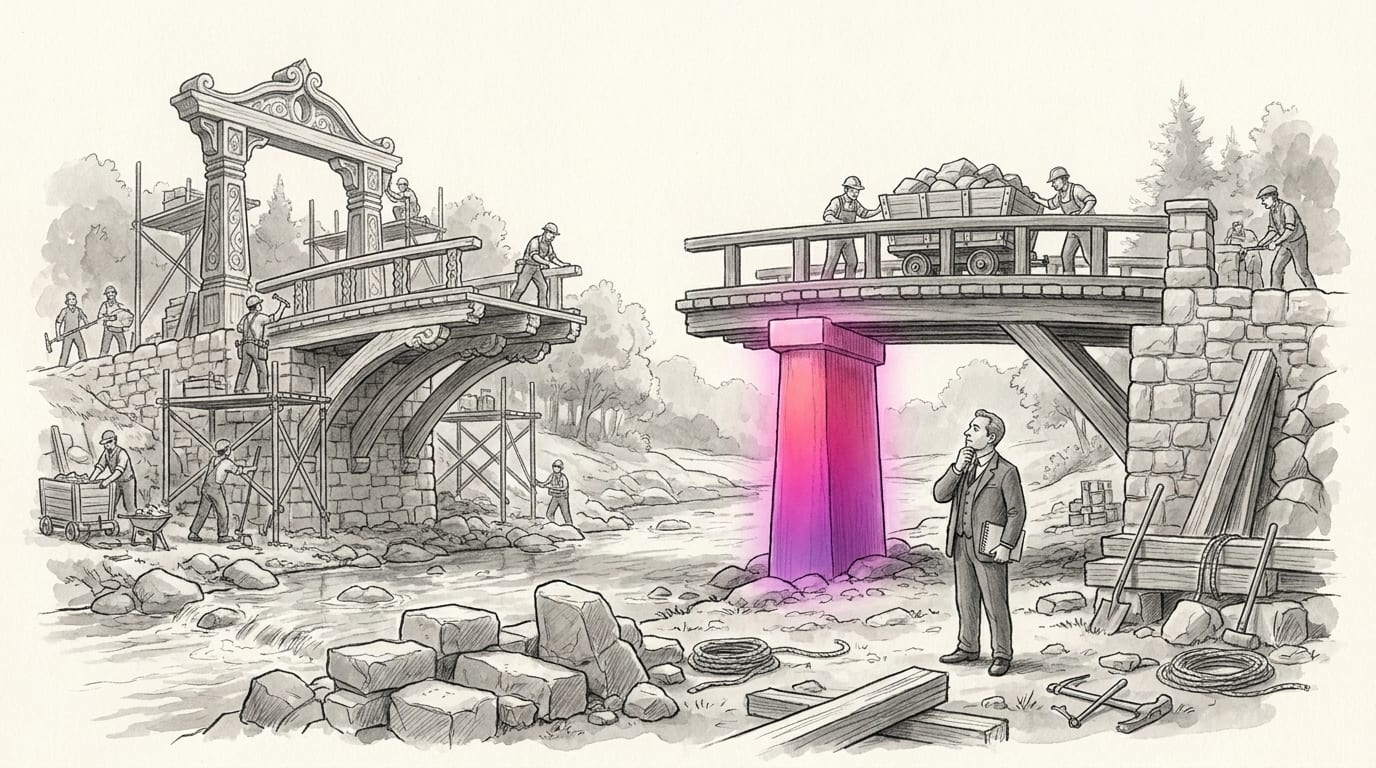
What evidence should you request before choosing a software house?
Start with an artifact you can inspect, rather than a promise you cannot test. Here is a real receipt from our published methodology, not a claim about an unnamed client:
“The spec is the bridge between human understanding and machine execution.” — Ganis Atmawarin, How We Develop Software Without AI Slop
The article shows our specification-to-validation sequence. For your procurement meeting, translate that principle into a small acceptance test. The example below is illustrative:
| Workflow | Input | Expected result | Evidence requested |
|---|---|---|---|
| Approve a purchase | An order above IDR 10m | Route to the designated manager | Recorded demonstration and test result |
| Prevent self-approval | Requester also has manager access | Reject approval of their own order | Permission test and visible error |
| Handle a repeated request | Same order submitted twice | Create only one approval | Repeat-submission test |
Ask each candidate to explain who writes these rules, who checks them, and where the result is recorded. A beautiful dashboard is the shop window; acceptance evidence lets you inspect the workshop.
Use our vendor due-diligence guide to expand this into a procurement checklist.
What is a software house, and what does it deliver?
A software house is a company that designs, develops, tests, and maintains software for clients. Its service scope can include websites, mobile apps, internal systems, integrations, and ongoing engineering support. The label alone tells you little about how it works.
A useful proposal spells out these deliverables:
- Map the business workflow and define acceptance criteria.
- Design screens and build the agreed software.
- Test permissions, integrations, and failure cases.
- Release into a named environment with monitoring.
- Hand over code, documentation, access, and support responsibilities.
A freelancer can cover a small, stable scope. Staff augmentation supplies engineering capacity when you already manage the product. A delivery team takes responsibility for agreed outputs. A consultancy combining strategy and execution helps decide what to build before building it.
These are engagement models, not quality rankings. One person with a precise brief can be a better fit than a large team without a decision owner. For a marketing site, start with our website development services guide.
How much does a software house cost in Indonesia?
There is no useful price comparison until scope, exclusions, and support match. These ranges are illustrative budgeting scenarios in IDR, not surveyed Indonesian rates or Synetica package quotes. Obtain written estimates for your actual requirements.
| Engagement | Example scope | Illustrative budget | Planning duration | Best fit |
|---|---|---|---|---|
| Small, fixed delivery | One internal workflow, minimal integration | IDR 40–90m | 4–8 weeks | A stable brief and an available business owner |
| Custom operational application | Multiple roles, approvals, reporting, one integration | IDR 150–350m | 10–16 weeks | A Growing Business replacing manual coordination |
| Connected multi-team system | Migration, multiple integrations, phased rollout | IDR 400m–1bn+ | 4–8 months | Several departments with shared operational data |
These examples assume design, implementation, and testing. Hosting, third-party subscriptions, applicable taxes, data cleanup, and ongoing support need separate line items. A large migration can change both cost and duration significantly.
Do not treat these durations as Synetica’s standard offer. Our two-week validation and eight-week production phases apply to an agreed, validated scope, with access and decisions ready. Define that scope through Blueprint & Prototype before asking for a production commitment.
How do you choose a software house? Five checks with named owners
Assign each check to a person on your side who can judge the evidence. The owner labels below are suggested responsibilities, not invented testimonials. Use the same questions for all candidates.
1. Scope clarity — owned by your business lead
A written workflow gives your team a shared map, including where the road ends.
What it helps you do:
- Identify the user and business decision.
- Define the result of each action.
- Record exceptions and exclusions.
- Separate launch scope from later requests.
Walkthrough: for purchase approvals, ask the vendor to document the IDR 10m threshold, permission rules, and duplicate handling from the earlier table. “Approval module included” does not answer any of those questions.
Question to ask: “What happens if a requester tries to approve their own order?”
Why this matters: disagreements become visible while they are cheap to resolve. A candidate that asks about exceptions is doing useful discovery, even if the conversation takes longer than the sales demo.
Map the riskiest workflow in Blueprint & Prototype.
2. Delivery evidence — owned by your technical reviewer
A testable release is a load test for the vendor’s process.
What it helps you do:
- Inspect one comparable working feature.
- Review how failed tests are handled.
- Trace a requirement into a release.
- Check how changes reach production.
Walkthrough: choose three acceptance cases: a successful request, a permission denial, and a repeated submission. Ask for redacted evidence or a sample project if client confidentiality prevents access. You need a demonstrable method, not another client’s private code.
Question to ask: “Show how a failed acceptance case blocks release.”
Why this matters: a portfolio proves that something was displayed; it does not explain how quality is maintained. If you lack an internal technical reviewer, arrange an independent review before comparing complex proposals.
See our specification, testing, and validation approach.
3. Team continuity — owned by your project owner
Named responsibilities make the engagement a relay with a planned handoff.
What it helps you do:
- Identify the daily decision contact.
- Confirm who reviews engineering work.
- Plan coverage for an unavailable lead.
- Record decisions outside personal chat.
Walkthrough: ask who takes over if the lead developer is absent for five working days. Inspect the onboarding notes and backlog another engineer would use. Team size alone does not show whether knowledge is shared.
Question to ask: “Who can deploy and troubleshoot this system when the lead is away?”
Why this matters: a backup person without access or documentation is only a name. For a Dreamer with a small scope, a freelancer can still fit; agree on a handover process and realistic availability.
Compare engagement models in our outsourcing guide.
4. Ownership and operations — owned by your operations lead
Handover is the spare key you should check before moving in.
What it helps you do:
- Confirm business access to required accounts.
- Inspect a backup restoration example.
- Define incident escalation responsibilities.
- Agree on exports and deployment documentation.
Walkthrough: request a restore demonstration using non-sensitive test data. Ask the team to show which environment receives the restored backup and how they verify the records. An automated “backup successful” email does not prove recovery.
Question to ask: “What can our next maintainer run without calling your team?”
Why this matters: security work belongs throughout development. NIST’s SSDF v1.1 describes practices that can be integrated into the development lifecycle and a common vocabulary buyers can use with suppliers. Ask for evidence appropriate to your risk; a framework reference alone proves little.
Review production readiness with our Production Grade Software service.
5. Comparable cost — owned by your budget owner
A twelve-month model lifts the floorboards hiding the extra spend.
What it helps you do:
- Separate build cost from operating cost.
- Identify subscriptions and recurring fees.
- Estimate likely rework explicitly.
- Compare change-request assumptions.
Walkthrough: give each vendor the same scope and support period. Ask what a new approval role would cost after launch and who estimates it. Keep uncertain costs as assumptions rather than quietly adding them to a supposedly fixed quote.
Question to ask: “Which costs move if the integration or migration takes longer?”
Why this matters: a more expensive team can still deliver poor value. Pay more only when the additional scope or reduced operational exposure matters to your business.
Use the total-cost example below.
Validate it in 2 weeks. Before committing to a large build, test the risky workflow with relevant users. Blueprint & Prototype produces a working prototype and decision-ready scope; production follows after the validation decision.
What does a cheaper software house quote cost over twelve months?
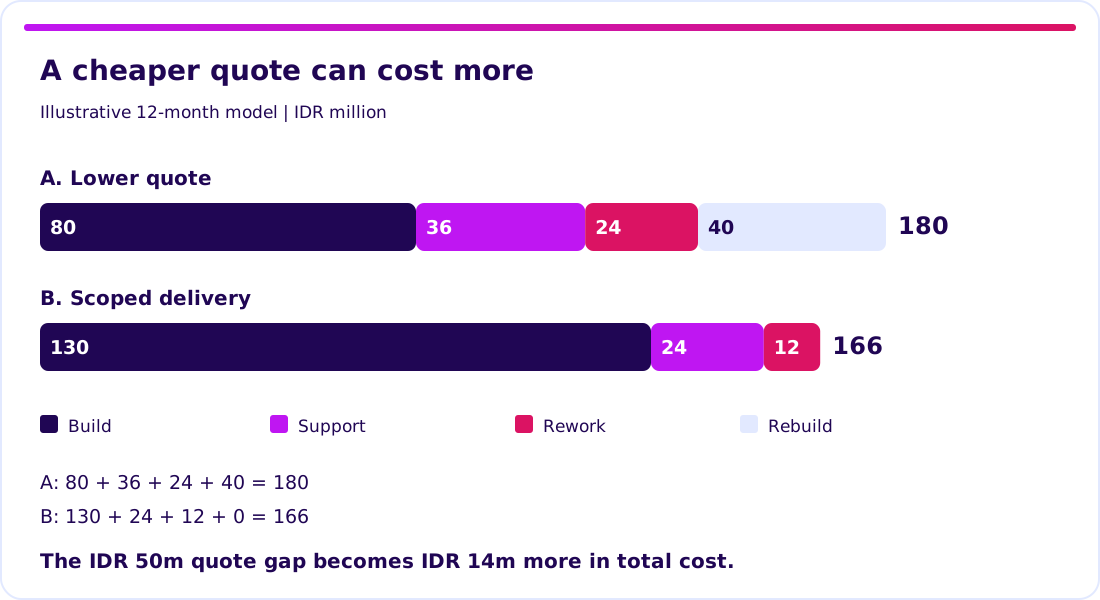
Total cost can reverse the ranking of two quotes, but only under stated assumptions. The figures below are a worked simulation of two approaches to the same application, not actual vendor invoices or a forecast.
| Twelve-month component, IDR m | A: lower quote | B: scoped delivery |
|---|---|---|
| Build | 80 | 130 |
| Support | 36 | 24 |
| Rework | 24 | 12 |
| Rebuild (assumed) | 40 | 0 |
| Total | 180 | 166 |
A’s assumed costs are IDR 80m build + 36m support + 24m rework + 40m rebuild = 180m. B’s are IDR 130m build + 24m support + 12m rework + 0 rebuild = 166m.
The initial quote gap is 50m. The twelve-month total favors B by 14m. But remove A’s assumed rebuild and its total drops to 140m, making it 26m cheaper than B. That sensitivity is the point: challenge the assumption that creates the advantage.
This model excludes downtime, delayed revenue, hosting, subscriptions, and taxes. Add a cost only when you can describe its basis. Do not invent a disaster to justify a premium vendor.
Bring your scope and cost assumptions to a scoping conversation.
How can you score software house proposals fairly?
Resolve operational gaps before applying weighted scores. Below is a suggested buyer scorecard, not a validated industry benchmark.
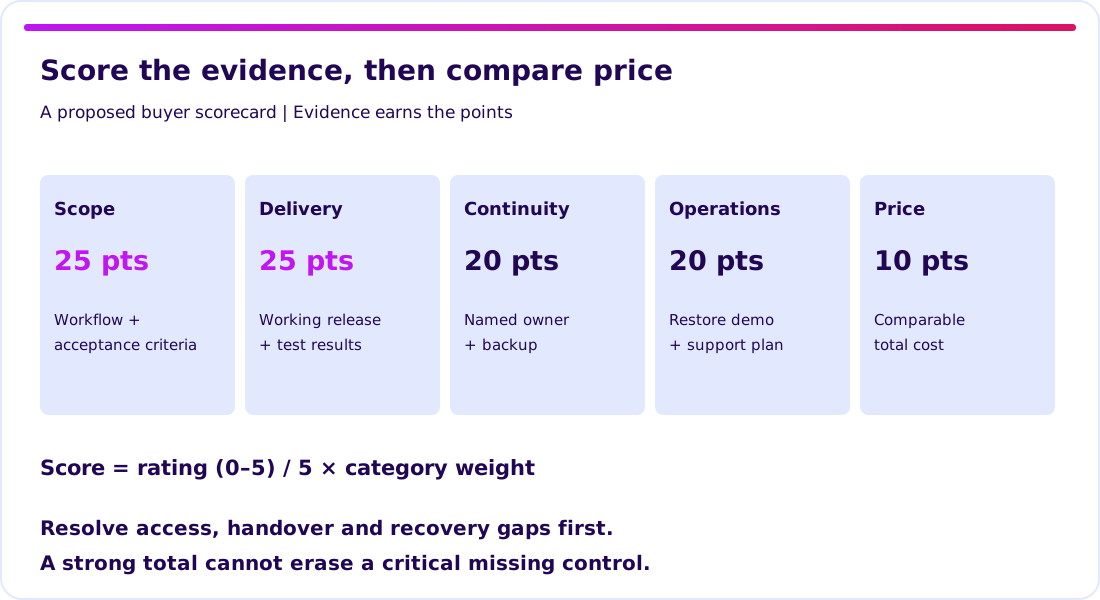
For each category, use a 0–5 rating: 0 means no evidence; 3 means documented evidence with unresolved questions; 5 means demonstrated evidence your reviewer accepts. Calculate rating ÷ 5 × weight. A scope rating of 4 earns 20 of the available 25 points.
Keep a short note explaining every score. Two reviewers should be able to trace it back to an artifact, not “they seemed professional.” Adjust the weights to your risk; a small brochure site does not need the same review depth as an operational system.
Missing business access, unclear handover, or an unproven recovery plan should trigger follow-up before approval. A total of 85 cannot erase a critical missing control.
Use the due-diligence questions alongside this scorecard.
How long does software house development take from brief to launch?
A timeline needs dependencies and decision gates, not just a launch date. Synetica’s 2B2G sequence is illustrated below; complex integrations or migrations require an explicitly adjusted scope and schedule.
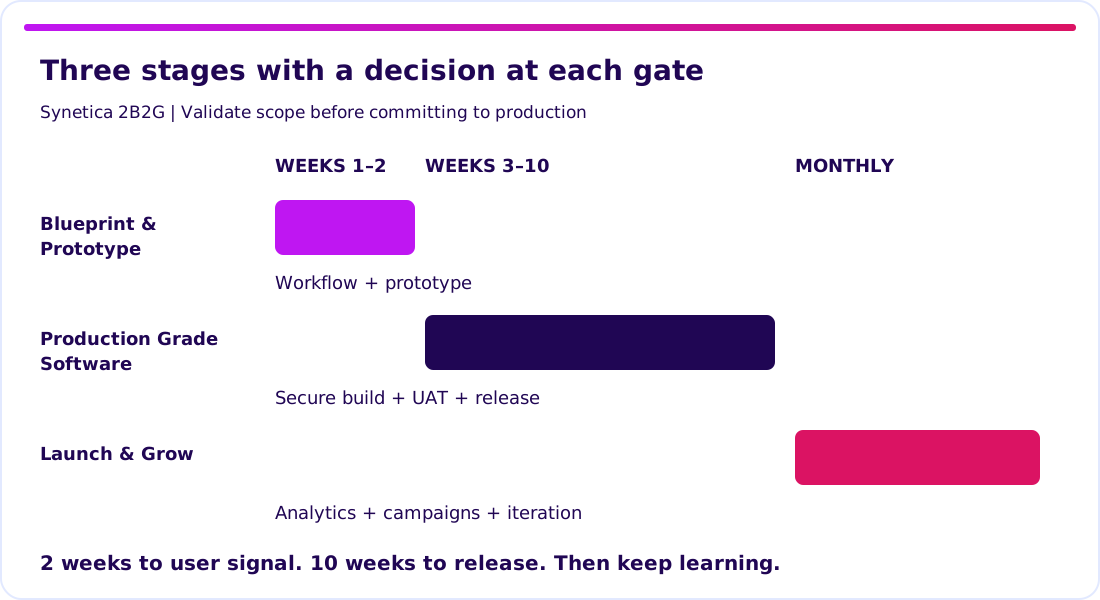
In Blueprint & Prototype, we clarify the workflow, prioritize scope, and collect user signal with a working prototype. The gate is whether the direction deserves a production investment.
In Production Grade Software, we build the validated scope, test integrations and permissions, prepare monitoring, and complete user acceptance and release work. The complete validation-to-release path is ten weeks under the agreed conditions.
Launch & Grow continues through a monthly retainer: launch, analytics, campaigns, and product iteration. Ask which metric the first cycle will inspect and who decides the next change.
Martin Fowler’s discussion of cycle time explains why start and end definitions matter when comparing delivery speed. For procurement, state whether the clock ends at a demo, a production deployment, or an accepted release available to users.
Review the validated production phase with your access, integration, and approval dependencies ready.
What are the red flags when choosing a software house?
A red flag is an unanswered operational question, not a low quote. Slow down when a candidate cannot show:
- How “done” is accepted for a real workflow.
- Which integrations, migration tasks, and support items are excluded.
- Who owns delivery decisions and provides backup coverage.
- How your team receives usable code, access, and documentation.
- What happens after a failed deployment or unavailable service.
Treat “AI makes everything faster” the same way you treat “our developers are senior”: ask for the relevant evidence. A polished sales answer is a starting point, not a release artifact.
Take these questions into a vendor review before the final comparison.
What I would do before hiring a software house
I would send every candidate one workflow, one acceptance example, and one support expectation. That creates a useful comparison sooner than a long feature wishlist.
For Growing Businesses, I would prioritize recoverability, team continuity, and the operational integration. For Dreamers, I would check whether an existing tool or a smaller prototype can answer the business question before funding a custom build.
Synetica combines strategic thinking and execution. The fastest path from ideas to user signal starts with a focused test, then a deliberate build decision.
Your next step: bring your riskiest workflow to Blueprint & Prototype.
FAQ — Software House
What does a software house do?
A software house designs, develops, tests, releases, and maintains software. Discovery, migration, hosting, and support vary by agreement, so request a deliverables list and explicit exclusions.
How much does a software house cost in Indonesia?
Our illustrative budgets run from IDR 40–90m for a small fixed workflow to 150–350m for a custom operational application and 400m–1bn+ for a connected system. These are planning scenarios, not market rates or vendor quotes.
How do I find the best software house in Indonesia?
Compare candidates against your scope using evidence for delivery, continuity, ownership, operations, and total cost. A city, award, or portfolio ranking cannot determine the best fit for your workflow.
How long does a software house take to build an application?
Duration depends on scope and readiness. Synetica’s validated path uses two weeks for Blueprint & Prototype and eight weeks for Production Grade Software, then ongoing Launch & Grow. A larger migration needs its own schedule.
What is the difference between a software house and a freelancer?
A freelancer usually offers an individual’s capacity; a software house can supply a coordinated team. Check actual coverage and responsibilities in both cases. Neither label guarantees quality or continuity.
Related Posts
Two weeks to a real answer
Need help putting this into practice?
Book a Blueprint session and we'll turn the ideas in this article into a tested prototype in front of real users—2 weeks, from $3,000.